Friday, 23 February 2024

Islamic Art


During our Middle East study, we learned a lot about Islamic Art. As Muslims, we don't draw people, so much of our art consists of geometric shapes, patterns, and nature. 

These are the two main books we used as references. 

The first lesson we started with was learning about symmetry. The boys used pattern blocks to make designs and the others copied the design on the opposite side. 


After the boys understood that Islamic Art is all about symmetry they got to work on making their own geometric patterns and designs. 


We watched this short video

This study was part of our Iran country study and bridge lesson. Khaju Bridge in Isfahan, Iran has the most beautiful arches and ceramic tile art. The boys and I did a unit study on this bridge. If your interested you can grab this unit study from my TPT store. Click on the image below. 


Monday, 4 September 2017

Nature Collage and Teaching Your Kids to Reflect


Hi guys! Today I wanted to share with you one of the activities that goes along with our seerah series. The Prophet (SAW) would often go off in seclusion and reflect on the purpose of life. So did a lot of the Anbiya. They were shepherds, this allowed them to stay connected with nature and be in a state of constant reminder of Allah.

I am not a nature lover (there I said it). But after reading the importance of staying connected, I try to make more of an effort to be outside and just sit in silence and reflect. My boys have also gotten into the habit of sitting outside and sketching and connecting with their lord.

It isn't enough to be out in nature, anyone can go outside and just stare at the sky. We must know how to properly reflect and connect it back to the Quran and our purpose of life.


The lesson comes with

1. Material list
2. Nature Reflection Tips and Ideas
3. Step by Step picture instructions
4. Links to Videos
5. Book Suggestions
6. Nature Collage Craft


You can head over to my TPT store to grab this lesson along with other lessons from our Seerah Series.
https://www.teacherspayteachers.com/Product/Seerah-of-the-Prophet-SAW-Lesson-3-4-3374036
Click on the Image to purchase this lesson

https://www.teacherspayteachers.com/Product/Seerah-of-the-Prophet-SAW-Lesson-1-2-3371201
Click on the image to purchase this lesson.

Seerah Lesson 3-4


Hi guys! I've been working really hard to try to gather all the lessons we've done so far for you. Today I wanted to share with you lesson 3 and 4 in our Seerah series. You can go to this post to check out lesson 1 and 2.

These two lessons deal with the Prophet's time in the desert with Halima Sadia and his love of nature. I have suggested reading, book list, videos, nature reflection, and a nature collage.

Lesson 3


It was part of the Arab custom to send newborns to the desert to live with wet nurses. You and your kids will read and watch videos about the desert. You will also do a fun cactus directed drawing as well as write about what you have learned.


Lesson 4

The Prophet (SAW) loved being in nature and reflecting on the purpose of life. Many times in the Quran Allah commands us to ponder over his creation. You and your kids will go on a nature walk and reflect on the beauty around you. I have included some tips on how to reflect and bring it all back to the Quran. Once you complete your nature walk, the children will complete a nature collage.


I hope these lessons are of benefit to you.

https://www.teacherspayteachers.com/Product/Seerah-of-the-Prophet-SAW-Lesson-3-4-3374036
Click on the image to purchase this lesson.


Thursday, 31 August 2017

Cave of Hira Model: Islamic Studies


Hi guys! Today I wanted to share with you a really fun hands on project. The boys and I worked on a diorama of the Cave of Hira. This year we are covering the seerah of the Prophet (SAW). To make our learning more fun and memorable we put a diorama together.


Completed project.


Thursday, 15 December 2016

Art History: Henri Mattise


Hi guys! This Thursdays art history lesson was all about Henri Matisse. We watched a video all about his life, read a few books, and recreated one of his famous creations.

What We Learned:
  1. He was born in France in 1869
  2. He studied to become a lawyer but fell ill shortly after that
  3. His mother purchased him some paint and he was hooked ever since
  4. He became to ill to stand up and paint on the easel
  5. He began creating scenes out of shapes
  6. He called his work "scissor painting"
 Resources:

 We read from The Usborne Art Treasure

 We listened to a reading of Henri's Scissors on YouTube.

We also enjoyed this animation video on Henri Matisse's life


Art Work

The boys worked on a collage pieces using instructions from the Usborne Art Treasure book. 

The boys cut up all their shapes. We talked about the best way to layer the shapes (large pieces first, medium size pieces next, and the small pieces last)


That's it for our artist study! The boys have already chosen the next artist they want to study about, Damien Hirst. They were fascinated with the his spin painting technique.

Linked Up With:
Preschool and Kindergarten Community


Thursday, 1 December 2016

Art History: Kandinsky


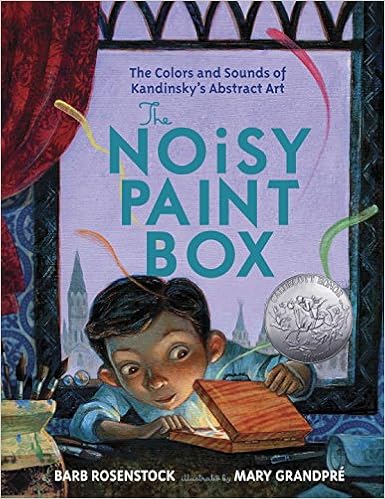
Hi guys! As part of our morning basket on Thursday we work on a little art history. We read a book about an artist, watch a video, and recreate a piece by the artist. We recently learned all about Kandinsky and recreated one of his famous pieces.

What we learned:
  1. His art work is called abstract
  2. He listened to music while painting
  3. He painted what the music made him feel
  4. He was born in Moscow Russia
  5. His paintings are made of lots of shapes
  6. He was a teacher and started art when he was 30
  7. He died at the age of 78
 Resources:

We read out of The Usborne Art Treasury

Image result for kandinsky picture books
We also read this picture book. I borrowed it from the library as an e-book. 


We watched a brief biography on youtube. 

Art Work:

We recreated his circles painting using oil pastels and water colors. 

I gave the boys card stock paper that I folded making 6 squares and they drew circles in each square leaving space between each circle. 

Once they drew all their circles they painted each square a different color using water colors. 


That was an easy, fun artist study!

Linked Up With:
Preschool and Kindergarten Community 
Practical Mondays


Thursday, 22 September 2016

Fresco Secco


Hi guys! Today I wanted to share an art project we worked on after reading chapter 5 in Story of the World vol. 2. Fresco Secco is the technique of painting on dry plaster with pigments mixed in water. These beautiful works of art have held up centuries after their creation. I didn't follow the instructions in the book we just kind of did our own thing.

Material:
  1. Plaster of Paris
  2. Water
  3. Cups and spoons (for mixing the plaster)
  4. A piece of burlap
  5. art medium of your choice (we used pastels)
  6. Cardboard (to protect your surface)
  7. White glue
*** NEVER POUR WET PLASTER DOWN THE SINK***

Mix the Plaster according to the box, pour it over the burlap and let it dry for 24 hours. I put a piece of cardboard under the burlap to protect my surface. Once the plaster dries have your child sketch out what they want to draw because once you paint/draw on the plaster you can't erase it. Now comes the fun part CRACKING the plaster to give it an old rough feel. The boys enjoyed making big and small cracks on the plaster (don't worry it won't fall off the burlap). Once we were satisfied with all our cracks we poured a generous amount of white glue over our surface and spread it using a Popsicle stick. Leave your creation to draw over night and you'll have a beautiful piece of art.


They turned out really nice and the boys enjoyed working on this process.

Linked Up With:
Practical Monday
Preschool and Kindergarten Community 
Related Posts Plugin for WordPress, Blogger...
01